
Aanchal Parmar
Product Marketing Manager, Flexprice

What happens when you need to change pricing mid-contract?
Mid-contract changes are where most billing systems give up.
I'm talking about
ramped commits (contracts where pricing increases on a set schedule, like $10K/month in Q1 rising to $15K/month in Q3),
mid-cycle overages (when a customer blows past their committed usage halfway through the billing period),
and parent-child hierarchies (where a corporate account has subsidiaries, each on different pricing tiers).
They're standard operating procedure for enterprise sales teams. And they create compound billing edge cases that cascade when a billing system handles them through manual workarounds.
When one subsidiary upgrades mid-cycle, the parent still needs a consolidated invoice with correct proration and currency conversion. If your billing system can't handle this natively, your finance team spends days in spreadsheets every month. And that's before anyone changes the pricing model.
When you're evaluating an enterprise billing system, ask about compound scenarios, not individual features. Every vendor supports proration.
Far fewer handle proration plus parent-child plus multi-currency plus a mid-cycle upgrade in a single billing run.
That definition of flexibility sounds reasonable in the abstract. But most billing platforms claim to deliver exactly this. So how do you tell the difference?
Why do most billing platforms fail the flexibility test?
Most billing platforms fail the flexibility test because they treat pricing model support as the finish line when it's actually the starting gate. Every vendor's demo shows subscription, usage-based, and hybrid pricing. Add multi-currency, CRM integration, automated invoicing, and tax compliance.
That's the standard checklist every enterprise billing system passes.
And it tells you almost nothing about how the platform performs when you actually need to change something.
We see three patterns repeatedly
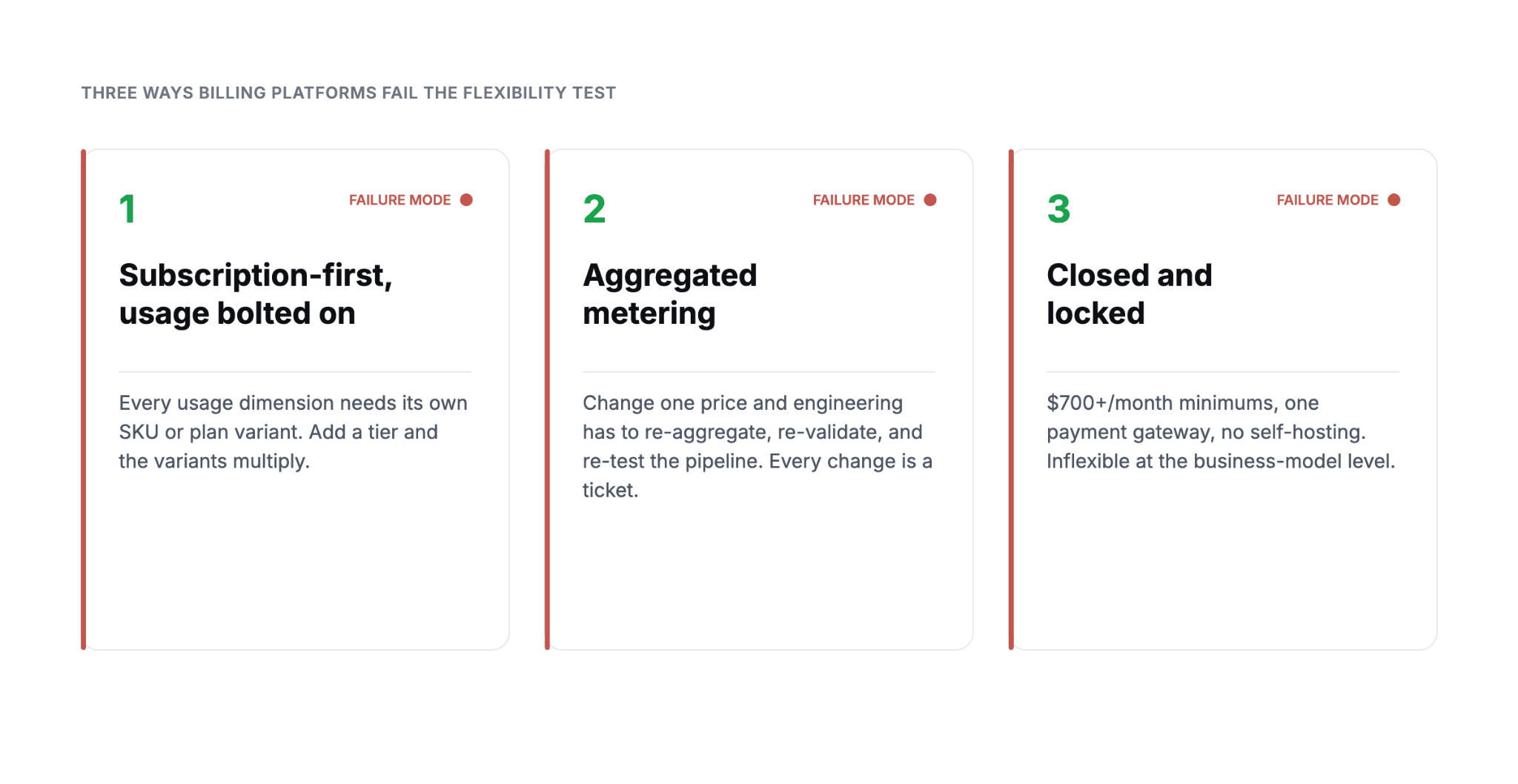
Subscription-first platforms that bolted on usage later
Each usage dimension needs its own SKU, addon, or plan variant. Billing for API calls, storage, and compute hours means three metered features, each multiplying your plan variants with every new tier. Teams spend months on setup and still can’t iterate. When you’re building workarounds, the platform isn’t flexible.
Aggregated metering models that require re-processing when pricing changes
You set up your metering pipeline and aggregation rules, and everything works until someone changes the price per unit.
Then engineering has to re-aggregate historical data, re-validate against the new rate, and re-test end to end. Every pricing change triggers a ticket. If each change takes a week, it’s not flexibility you can use.
Closed platforms with $700+/month minimums, single-gateway locks, and no self-hosting option
These platforms are inflexible at the business model level. If you operate in India or the GCC and need Razorpay or Moyasar, one locked gateway kills you. The real test: can Product change pricing without Finance losing visibility or Engineering getting pulled into a sprint?
What capabilities make an enterprise billing system flexible?
A flexible enterprise billing system needs metering, pricing, credits, entitlements, and invoicing to work as one connected pipeline, so a negotiated contract and a self-serve plan can run side by side without forking your setup.
Here's what the system actually has to handle:
High-throughput metering
Ingest usage events (tokens, API calls, voice minutes, GB, pages) at scale and low latency, with idempotency and deduplication so retries and late-arriving events never double-count. Get metering wrong and every invoice downstream is wrong, and enterprise customers will catch it.
Flexible aggregation
Turn one event stream into different meters, sum, count, unique count, max, or latest value, because a single AI product often bills on several dimensions from the same activity (input tokens, output tokens, requests).
Pricing model flexibility
Support the full range on the same product line, often at the same time:
Pure usage-based, per unit
Tiered and volume pricing
Prepaid and credit-based billing
Hybrid: a base fee plus overage, or a commitment plus usage
Per-seat combined with usage
Fully custom enterprise contracts with negotiated rates
Credits and prepaid balances
Credit grants, expiry rules, rollover, top-ups, and real-time drawdown against live usage. It's its own subsystem, not a pricing afterthought.
Real-time usage visibility and entitlements
Customers see consumption close to real time, and you enforce quotas and rate limits by plan, with entitlements you can query fast.
Enterprise contract handling
Commitments and minimums with overage, ramp deals, multi-year terms, overage factors, per-contract entitlements, parent and child accounts with consolidated invoicing, and negotiated overrides that coexist with your self-serve plans instead of forking your setup.
Accurate invoicing and mid-cycle changes
Proration, mid-cycle upgrades and downgrades, line-item detail finance teams can reconcile, tax, and multi-currency. Enterprise finance audits line items, so 'trust me' totals don't fly.
Cost and margin visibility
COGS against revenue per customer, so you can see when a heavy user quietly goes margin-negative. This matters most in AI, where you pay model and infra providers while you bill the customer.
Multi-gateway payments and collections
Stripe, Razorpay, and others, plus the accounts-receivable side, dunning, retries, and actually getting paid once invoices get large and negotiated.
Auditability and reconciliation
Prove that what you charged matches what was consumed, both to hold customer trust and to stay sane internally as event volume grows.
Metering, pricing, credits, entitlements, and invoicing have to be one connected pipeline, with self-serve plans and sales-led contracts living side by side. Bolt usage billing onto a subscription tool, or hand-roll it on top of a payment processor, and it breaks at exactly the point the business starts to scale.
How should you measure enterprise billing flexibility of any vendor?
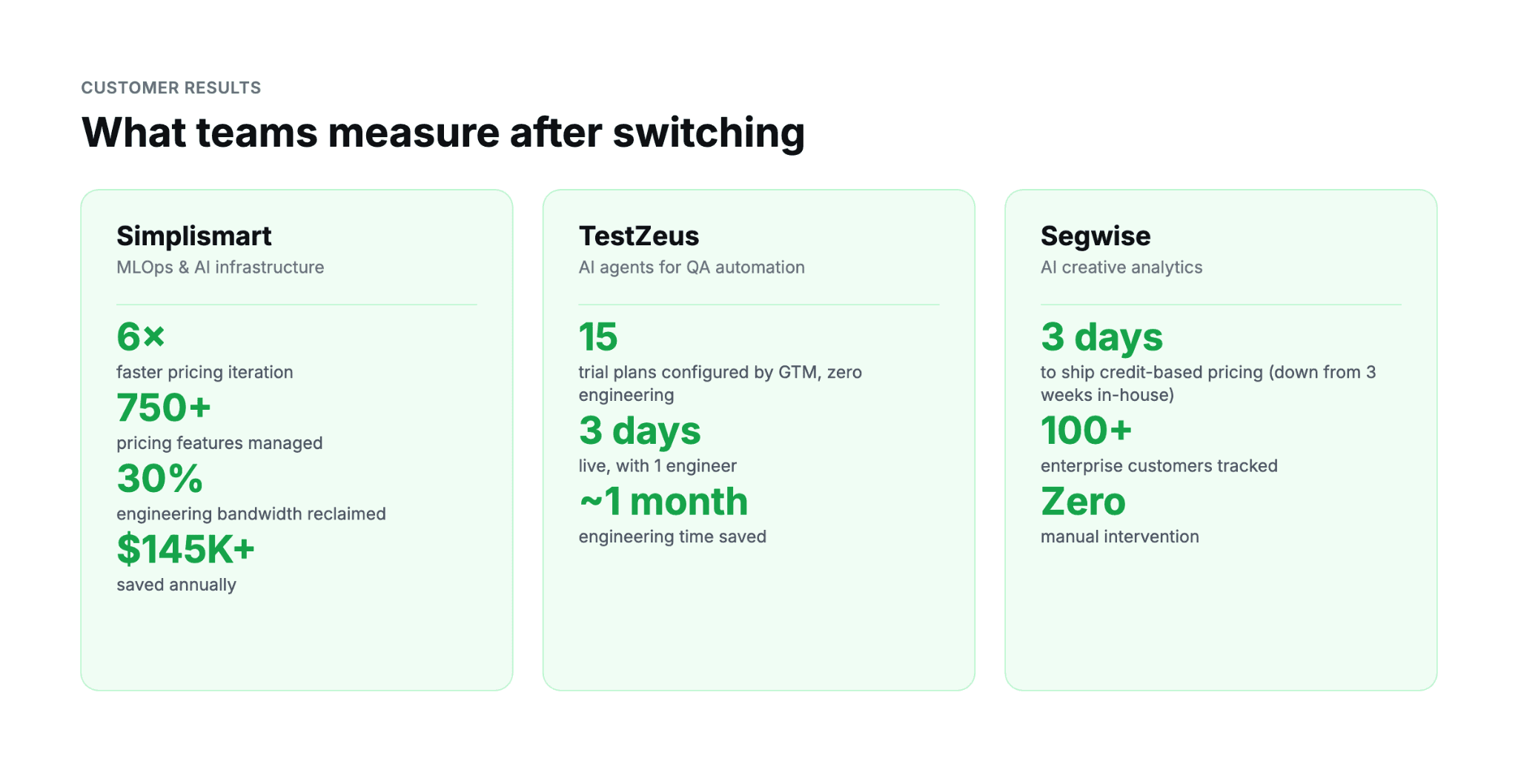
Measure billing flexibility by how much engineering time it saves, how fast they can iterate on pricing, and whether the system keeps up as complexity grows. We've tracked these outcomes across multiple teams that switched, and the patterns are remarkably consistent.
What questions should you ask when evaluating billing flexibility?
The right questions expose the gap between "we support flexible pricing" and "you can actually change your pricing." Here are five we'd bring into any enterprise billing solution evaluation, based on the patterns we've seen
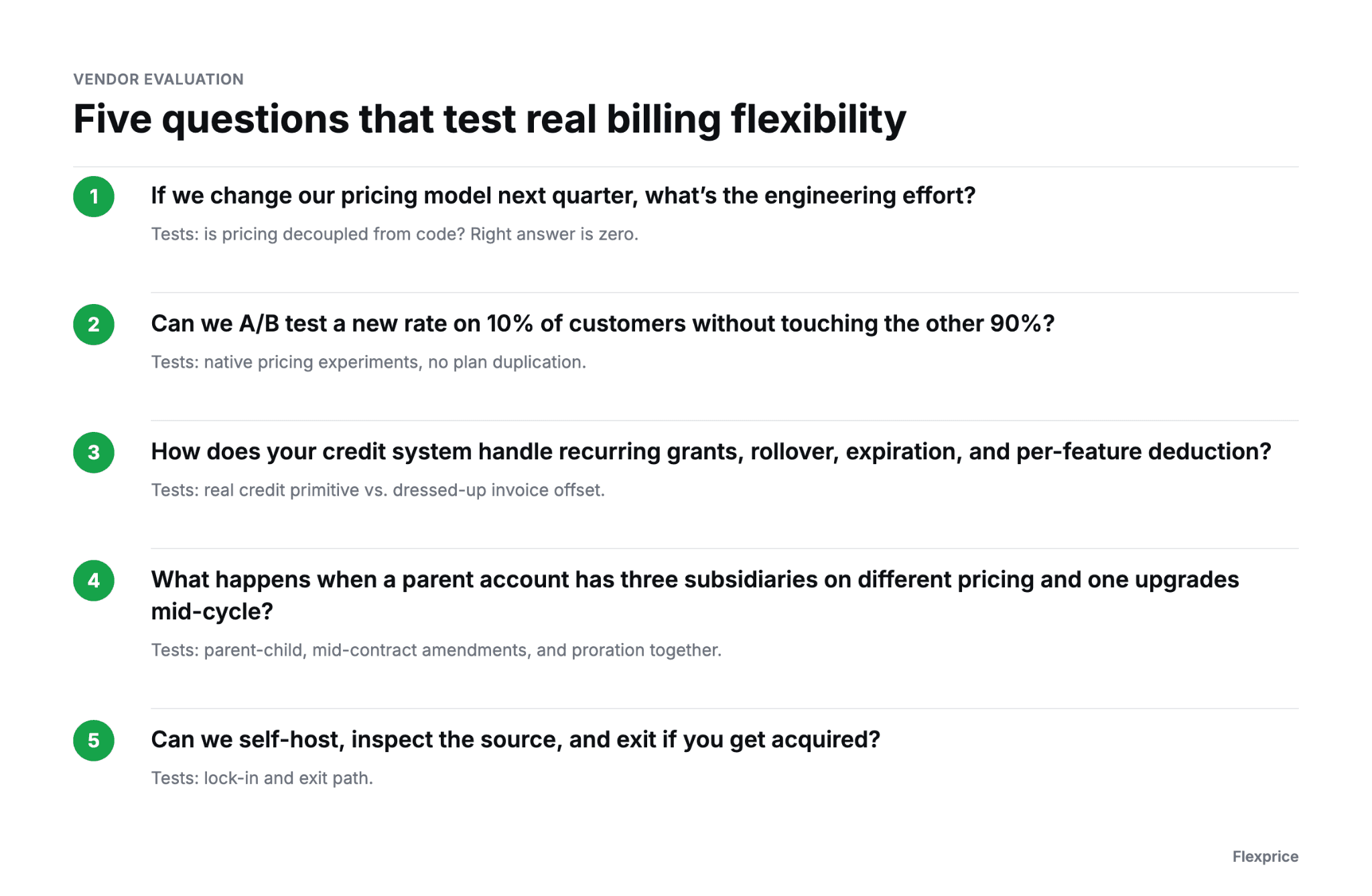
1. "If we change our pricing model next quarter, what's the engineering effort required?"
This tests whether the system decouples pricing from code. The right answer is zero. Product changes pricing in the dashboard.
Engineering doesn't get a ticket. If the vendor says "minimal engineering involvement," press them on what minimal actually means in their system. A one-line config change, a YAML file update, or a two-week sprint with QA?
2. "Can we A/B test a new rate structure on 10% of customers without affecting the other 90%?"
This tests whether the platform supports pricing experiments natively. Most platforms can't do this without duplicating plans, creating parallel SKU structures, and managing the merge manually. If the answer involves "we'd recommend creating a separate plan," that's a workaround.
3. "How does your credit system handle recurring grants with rollover, expiration, and per-feature deduction rules?"
This tests whether credits are a core billing primitive or just an invoice offset relabeled as a credit system. If the credit system can't handle recurring grants that auto-renew, segmented by feature, with custom deduction order, it's promotional credits, not a credit wallet.
4. "What happens when a parent account has three subsidiaries, each on different pricing, and one upgrades mid-cycle?"
This tests parent-child account support, mid-contract amendments, and proration in combination. Each is straightforward on its own. Together, they create compound complexity that surfaces architecture limitations fast.
5. "Can we self-host this? Can we inspect the source code? What's our exit path if you get acquired?"
Billing platforms get acquired, and that's not a hypothetical risk anymore. If the vendor's answer to the acquisition question is "we'll continue to operate independently," that's what every acquired company says for the first 12 months.
Then the acquirer's roadmap takes over, integrations shift toward the parent company's stack, and your billing infrastructure is suddenly someone else's strategic decision.
The question is whether you have an exit path that doesn't require rebuilding your billing stack from scratch. An open source billing platform with self-hosting gives you that exit path. Closed-source platforms with single-vendor lock-in don't.
When you bring these questions to your next vendor evaluation, the answers will separate the platforms that are genuinely flexible from the ones that just have a long feature list.
What is a flexible enterprise billing system?
How often do enterprise companies change their pricing models?
What's the difference between credit wallets and promotional credits?
Should enterprise teams build or buy billing infrastructure?
How is enterprise billing different from subscription billing?